Monday, August 12, 2013

Turtle Facts #1

I wanted to put together some of the information that I learned at the symposium/information I know about turtles and tortoises! Hopefully some of the facts will help to spread awareness about issues that chelonians are facing and help to show the importance of conservation.

  • In Madagascar, tribes use to have taboos against eating tortoises. These started breaking down in the 1970s when outsiders started to move in. There has been an increase in the number of confiscations of tortoises recently from Madagascar (which is hopefully due to an increase in security rather than an increase in poaching).
  • The Magdalena River Turtle (Podocnemis lewyana) is facing a loss of nesting beaches due to a hydroelectric dam built on the Sinu River that drains water during the summer. This is when the turtles are nesting, but the water levels are too high to allow the eggs to survive the flood. Now the eggs have to be taken from the sand, incubated, hatched, and released back into the wild.
Madgalena River Turtle
  • The Black-Softshell Turtle (Nilssonia nigricans) was earlier thought to be extinct until some were found in a temple pond in India.
Black-Softshell Turtle
  •  The Northern River Terrapin (Batagur baska) is really cool:
Batagur baska male in mating colors
  • It estimated that the Indian Red Crowned Roofed Turtle's (Batagur kachuga) wild population contains less than 500 adults.
Indian Red Crowned Roof Turtle
  • There are less than ten adult female Burmese Roof Turtles (Batagur trivittata) left in the wild and about 650 in captivity.
Burmese Roof Turtle
  • The Arakan Forest Turtle (Heosemys depressa) is known as the "lazy turtle" amongst locals because when they are found they are usually hiding under leaves.
Arakan Forest Turtle
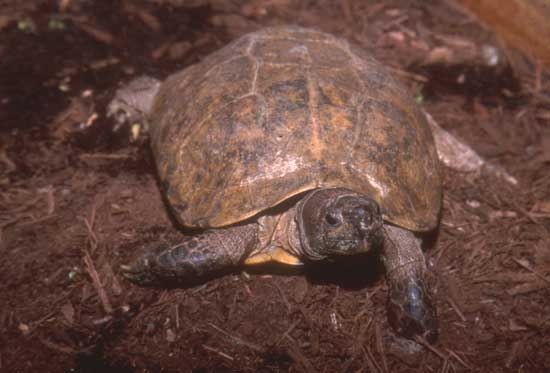
  • There was old lore that the Spotted Box Turtle (Terrapene nelsoni) was a cross between a Gila Monster and a desert tortoise since it was more aggressive and 'potentially venomous'.
Spotted Box Turtle

Turtle Survival Alliance Symposium

From the night of Wednesday the 7th to the night of Saturday the 10th I spent my time surrounded by over 200 other turtle and tortoise enthusiasts at the Turtle Survival Alliance's 11th Annual Symposium on the Conservation and Biology of Tortoises and Freshwater Turtles here in St. Louis! It was truly an amazing thing to be completely surrounded by other people who have the same passions for conservation that I do. I met a lot of new people at the conference that I know I will be in contact with over the years. I also met people that are well known for their research on turtles and tortoises! I talked to one person who had given a presentation about migration studies on the giant tortoises in the Galapagos and through him I might be able to work in the Galapagos in a few years! I even met people that have worked with one of my professors at school with either Gopher Tortoises or river terrapins. It was so much fun being able to talk to other people about their work and I look forward to seeing all my new friends at next year's symposium!

Not only did I meet new people, I was able to connect more to people that I knew from the zoo. I was able to talk more to our curator about his PhD work in Armenia, my manager about miscellaneous turtle and work topics, and talk to a zookeeper and fellow turtle enthusiast about everything turtles. I also got to talk to our state herpetologist more during the week. I really enjoyed getting to spend time with people from work in a more laid back setting.

The conference started with an ice breaker social on Wednesday night where I got to meet a lot of new people. Thursday was the first day of presentations (general session set up) about field site updates and then a focus on Mexican turtles. Thursday night was a casual pizza dinner and poster session.

Epic watermelon turtle at the ice breaker
Friday was the first day of specialized presentation topics. There were two sessions going on simultaneously throughout the day and attendees could pick and choose which presentations to attend. Friday I attended presentations about Turtle Ecology Studies, Nesting Studies, and a section about Zoos and Chelonians. In the final section of the day, one of our zookeeper gave a presentation about the history of chelonians at the zoo. Friday night was my favorite night of the conference because everyone came to the Saint Louis Zoo for a tour of the herpetarium and a dinner/live auction. I volunteered to help out for the behind the scenes tour and I was stationed at the main entrance into the off exhibit area. I got to talk about three different species of baby turtles that we have in the area as well as eggs that are currently incubating. I have worked this area a lot and helped to remodel the exhibits for the turtles last week. I really had fun talking to people that came in and I was proud of myself because I was able to answer a lot of questions that people had. Afterwards, a lot of people thanked the zookeepers and I for giving them a tour of our area. The dinner on Friday night brought about some laughs because by the time all of us zookeepers got to the banquet hall, the tables were full, so we sat at a table in the lobby and considered it the kid table at Thanksgiving.

Dinner and live auction at the zoo
Saturday I went to presentations about Conservation Initiatives, Asian Chelonians, Turtling Techniques, and Big Questions for Turtles of All Sizes. Saturday night there was a banquet and awards ceremony. The highest award in the organization is the Behler Turtle Conservation Award named after John L. Behler who was an avid turtle conservationist who brought attention to the Asian turtle crisis. This year the award went to the TSA's president Rick Hudson. The acceptance speech he gave was inspirational to me because he said that he has been doing what he wanted to do at 12 years old. For me, I remember that in 6th grade I wrote down wanting to be a sea turtle conservationist. I hope that maybe one day my turtle conservation work will leave behind a legacy and make a change for future generations.

This symposium was an amazing experience not only for the networking opportunities, but also because it strengthened my passion for turtle conservation. I am even more excited to go out into the field and start doing what I have been dreaming of since 6th grade. I know I am in the right field because I love being surrounded and engulfed by conservation, biology, and chelonians. I am excited about the new doors that are opening up for me as I begin the last two years of my undergraduate degree as well as opportunities for me after graduation. Even though it was a symposium on freshwater turtles, I started brainstorming ideas for an undergraduate research project with sea turtles.

Overall, this symposium was amazing and was a great cap on my internship experience. I learned so many things, met new people, and felt at home surrounded by other turtle enthusiasts. The three days went really fast, but I am already looking forward to reuniting with everyone again in Orlando next year!
For more information about the Turtle Survival Alliance, their field projects, the conference, or anything else turtles, check out 
http://www.turtlesurvival.org

Sunday, August 4, 2013

Day 42: Turtle and Tortoise Projects!

Saturday, August 3

This morning I went out to clean the giant tortoise yard. The tortoises must have wanted a lazy morning, because not even Othello came over to say hi. I worked on collecting other salad bowls, cleaned the black worms and did the dishes before the morning break! Today my family was at the zoo, so I was able to show them around a little and let them see more of what goes on during my internship. It was fun being a tour guide for them! I had a little time before lunch to prepare one of the new black tubs for a Northern Spider Tortoise exhibit. The Northern Spider Tortoise, Pyxis arachnoides brygooi, is native to Madagascar and is one of the three subspecies of Spider Tortoises: common Spider Tortoise (P. a. arachnoides), Northern Spider Tortoise (P. a. brygooi), and the Southern Spider Tortoise (P. a. oblonga). Out of the three subspecies, P. a. brygooi is the most rare due to the collection for the food and pet trade. Originally, native tribes collected the Radiated Tortoise, Astrocheys radiata, for food, but now since that tortoise population is dwindling, native tribes are turning to spider tortoises. The range of P. a. brygooi has been found to be much smaller than was expected according to a field study in 2009 led by Ryan CJ Walker. Conservation projects are being set in place to preserve the P. a. brygooi subspecies. Our zoo has had a successful breeding program of these tortoises for a few years now. A fun fact about these tortoises: they have a unique carapace (upper shell) design, so you can clearly identify them with just a picture.

After lunch, I finished setting up the spider tortoise tubs as well as an Egyptian Tortoise tub. After identifying the tortoises, we let them soak while finishing the new set up of their enclosures. We added new hide boxes and let the tortoises back in. The Egyptian Tortoise seemed to thoroughly enjoy his new space, but the spider tortoises seemed a little more confused on what just happened. After a little bit, they too started exploring and getting used to their new space. After break, the zookeeper and I started on a project of moving the Spotted Turtle, Clemmys guttata, around so they are more visible. The Turtle Survival Alliance is having their 11th Annual Symposium on the Conservation and Biology of Tortoises and Freshwater Turtles this upcoming week which includes a tour of the herpetarium. Hence why there have been so many turtle and tortoise projects lately (which, of course, I love helping with)! In order to get the Spotted Turtles set up, we had to move one of the Arakan Forest Turtles, Heosemys depressa, downstairs. We moved the tanks around but will have to set up new pluming in order to drain the tanks. The zookeeper and I talked about the conference at the end of the day and I am so excited to go! Stay tuned this upcoming week for conference updates instead of a 'today at the zoo' blog!

Northern Spider Tortoise

Egyptian Tortoise

My facts about the spider tortoises came from the Turtle Survival Alliance (TSA) 2009 magazine. (Which, if you like turtles and tortoises, I highly recommending finding some of these magazines to read. They are very informative!)

Day 41: Another Busy Salad Day

Friday, August 2

This morning we all did a quick cleaning of the glass and then the other intern and I started preparing salads. After the morning break, we finished salads, then I cleaned black worms and did the dishes. After lunch, I went out to cut browse for the Jamaican Iguanas. Once I was done, another zookeeper said that he needed help with a project. The Fiji Banded Iguana exhibit in the house is being remodeled (the Fiji exhibit I had done before is the temporary holding enclosure) so I had to clean the inside of the exhibit and then clean rocks to fill the enclosure with. Once the morning break was over, I helped the zookeeper bring in a large vine to place in the exhibit. I then cleaned large black tubs in order to prepare them for a turtle enclosure. The zookeeper who gave me this job and I then figured out what would be the best way to place the tubs in the space we have to work with. Our manager gave us a few ideas, but also told us to do whatever we felt best. We discussed how to set up the turtle tubs but the actual project would have to be saved for tomorrow!

Thursday, August 1, 2013

Day 40: So Much To Do, So Little Time

Today I started off cleaning the giant tortoise exhibit and giving some attention to Othello. I then gathered salad bowls from the building and cleaned the black worms. Today our female Komodo Dragon got a vet check up to make sure she is healthy. Only a few keepers were able to go in and work with her, but the rest of us stood outside the room and tried to watch what was going on. After the morning break, I did the dishes and started misting the galliwasps. Toady as the only intern again, I had the normal daily tasks to do by myself, and then was given tasks of taking care of animals for a keeper that wasn't here, along with miscellaneous tasks that needed to be done as well. Hence, there was so much to do today and not enough time to do all of it.

After lunch there was the intern tour of the Children's Zoo. Unfortunately, we did not get to go behind-the-scenes for this tour either, but since it is the Children's Zoo, we got to pet various animals. Technically I have gone behind-the-scenes there many years ago when I was in a Keeper for a Day program! Once back in the building, I was asked to clean off a drain in a turtle exhibit in the atrium. I finished misting the galliwasps, then changed a few baby McCord's Box turtle enclosures. After break, I cleaned the spotted turtle tanks and then was asked if I could clean the rodents downstairs. So I then changed shavings and cleaned cages for our rodents that we keep. By that time, I had to quickly go around and gather trash from the building and then help close. As you can probably guess, there were still things on my to-do list that did not get completed today. Looks like I will be very busy my next few days interning!

Wednesday, July 31, 2013

Day 39: Half Day

Sunday, July 28

I normally do not come in on a Sunday, but today I wanted to work a half day since I will not have many days left to intern with summer ending much sooner than I would like. I started the day with a quick misting of the galliwasps, then fed them along with the Mountain Chicken frogs and the Hispaniolan Giant Anole. I cleaned four snake enclosures as well as the Prehensile-Tailed Skink enclosure. I hadn't worked with this skink personally before, so that was fun. It was also interesting to take a little time to just look at the animal and see how amazing they are. After the morning break, I got set up outside to work more on the off exhibit cages that I had weeded earlier in the summer. In one of them I got to design from scratch a habitat for an Arakan Forest Turtle. These turtles are very good climbers, so I had to provide enough ground coverage/rocks/branches that would provide good exercise for the turtle. Once I was done, my design was approved by the zookeeper who gave me the task! It was really fun to build an exhibit again and I am definitely looking forward to seeing the turtle enjoying its new habitat! Today was a great day to come in because there is no salad to prepare or collect, so I was able to start working on other things right away!

Day 38: High Demand

Saturday, July 27

This morning I cleaned up the giant tortoise exhibit and the tortoise Othello came up to me to get some attention. I still think it is so cute that these huge tortoises recognize how to get attention and 'ask' for it. I picked up salads from the building and then started working in the cricket/rodent room. After break, I started working on dishes, but then the whole staff was called to help unload new caging units. We were all outside ready to help right away, but the truck was not there, so we had to wait a little bit for them to arrive. Back inside, I finished dishes and the cricket/rodent room.

After lunch, I cleaned black worms and then cleaned out McCord's Box Turtle and Spotted Turtle tanks. I then got to go inside the Madagascar Ground Boa exhibit to take out pieces of shed that were in there. I was in there with two snakes, but they did not seem to care that I was in there and were just watching what I was doing. Another example that snakes are not out to bite/attack humans for no reason. Cleaning the turtle tubs and the snake shed were tasks assigned by one zookeeper and while I was working on that another keeper asked me if I could help with other tasks. As the only intern today and having keepers off, my time was in high demand. I then worked on cleaning newspaper substrate in off-exhibit enclosures for various lizards and a turtle. By then, it was time for the afternoon break. Since I helped cleaning the lizard enclosures, the zookeeper that was giving me a 'tour' of the building yesterday was able to finish showing me different animals. I got to look at some really awesome animals including a New Caladonian Giant Gecko (that I was totally bonding with (also, this is the largest extant species of gecko in the world!)), a Haitian Dwarf Boa, a Crocodile Skink, a Garrido's Crested Anole, and a New Caladonian Roux's Gecko.

Garrido's Crested Anole

Crocodile Skink

Haitian Dwarf Boa

New Caladonian Giant Gecko